
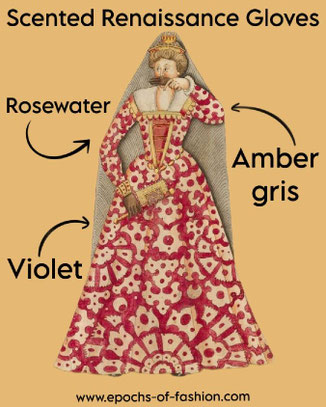
While strong odours are a common trope in stories and films about medieval and Renaissance people, contemporaries did in fact value fine scents and cleanliness. Spices, distilled waters and cosmetics provided a complex network of personal and socio-economical expression. Perfumes were considered sensual and capable of transporting the mind and heighten emotions, and promoting health. Scents were also markers of taste and prosperity.
Fragrances were applied to various articles of dress, but perfumed gloves were particularly prized objects. In Elizabethan England, gloves were worn by men and women ranging from simple woollen examples to expensive leather gloves with embroidered gauntlets. Glove-making was a thriving and highly specialised business, and due to the popularity of scents, it went hand in hand with perfumery. Entire gloves or their linings were washed in scents such as rosewater, violet, ambergris (derived from sperm whales) or orange blossom water. Because leather underwent extensive treatment before being made into fine gloves, perfumes could also be used to mask natural leather and residual tanning odours. Business records reveal that perfumers and glove-makers often collaborated, or individuals practised both trades.
Knowledge of perfumery was also integral to the maintenance of a noble wardrobe. Janet Arnold has observed in The Queen's Wardrobe Unlock'd that Elizabeth I employed a wardrobe keeper who was given a scent pan to diffuse fragrances into the queen's garments. Perfumed gloves also served as appropriate love tokens and diplomatic gifts. The embroidery of the gauntlets could carry symbolic meaning and the chosen scent for the gloves could express appreciation and a careful consultation of the tastes of the receiver.
At the same time, scents were believed to have powerful effects. Queen Elizabeth I carried fruit pomanders with cloves on her person to ward off sicknesses such as the plague. Homes were scented with fragrances to purify the air, and Renaissance doctors carried herbs to protect them.
At the same time, fears that gloves could pose a risk were present. Elizabeth I was apparently proud of her well-formed hands and often accentuated them by wearing, or deliberately not wearing gloves. She was gifted expensive gloves, but her advisor William Cecil attempted to restrict this due to fears of poisoning.¹ In an era of political uncertainty and unregulated access to herbs and substances, this was a real danger to any politically exposed figure. In Italy in particular, rumours surrounding the decease of various figures, such as among the Borgia or d'Este families, swirled. As a Protestant queen ruling a divided kingdom, Elizabeth was especially vulnerable but the vigilance of advisors like Cecil contributed to her survival into old age.
Cover: The image of lady holding gloves is a detail from Kostüme der Männer und Frauen in Ausburg und Nürnberg, Deutschland, Europa, Orient und Afrika, last quarter of the 16th century.
¹Nadine Akkerman and Pete Langman, Spycraft: Tricks and Tools of the Dangerous Trade from Elizabeth I to the Restoration (Yale, 2024), p. 211.
Never miss a new Post! Subscribe to The Epochs of Fashion Gazette!
I publish short reads on culture and society through the lens of dress, three or four times a month. Via the platform Substack these will then be sent to you as a newsletter.
Subscribing is free, although I really appreciate a small tip via my KO-FI account to enable me to keep Epochs of Fashion running.