
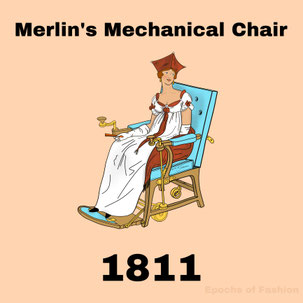
People in the early nineteenth-century, like today, experienced a variety of reasons to make mobility aids desirable or necessary. While the self-propelled wheelchair has been around since the seventeenth century, the invention spirit of the time of the industrial revolution coupled with cheaper, more affordable materials, produced new devices.
One such invention was Merlin's Mechanical Chair. It was developed by the enterprising John Joseph Merlin and the design features hand-cranks that propel the wheels forwards and backwards, an adjustable back which could turn it into a bed, and a footrest.
John Joseph Merlin lived from 1735 until 1803 and was a clockmaker, inventor, and maker of musical instruments. Also very invested in medical technology, he is reported to have developed
prosthetic devices and a set of whist cards for people with vision impairments. Educated chiefly in France, Merlin came to England in the retinue of the Spanish Ambassador in 1760 and settled
there. In London, Merlin ran a museum with displays of his
inventions such as musical automata. Some of his creations made a big impact on and were later bought by young Charles Babbage who went on to lay the foundations for our modern-day computers with
Ada Lovelace.
When Merlin died in 1803, his obituary line in The Monthly Mirror read ‘Merlin the ingenious mechanic’. His fame must have been so great that simply his surname and an adjective of praise for his skill and creativity was enough to convey to the readership who he was.
The posthumous advertisement of Merlin's
wheelchair design speaks to the importance of such engineering work for society. Contemporaries acknowledged that the Mechanical Chair, "his gouty-chair is certainly a
master-piece".² Discussions of the chair in print
highlight its stability indoors and on gravel paths outdoors, enabling the user to go about their lives as they pleased. King George III used his chair: “One of Merlin’s chairs was at this
time provided for him, with which he was so pleased, that he was constantly removed from one room to another in it” (Dodsley’s Annual Register for 1820). So also did Mary, Countess of
Chatham, as well as many other people who could get such a chair made. An original surviving chair remains in Kenwood House in London.
Further Reading and References:
¹ Richard D. Altick (1978), The Shows of London (Cambridge, MA: Belknap Press of Harvard Univ. Press), pp. 72–74.
² Broadsheet on John Joseph Merlin, Bodlein Library by Charles Benjamin Incledon (Waxworks 4 (42a)).