
With the urbanisation and the industrial revolution, entire industries were overturned in the eighteenth and early nineteenth century. With changes in society and in fashion, the making of cloth
and of finished garments also changed. Factories were created and drew a large workforce, but the fashion industries remained for some time a widely distributed network of cottage industry makers
or small workshops.
My choice of title, "fast fashion" is deliberate. Although fast fashion today is on an entirely different scale than in the early 1800s, the practice of churning out garments cheaply and quickly
is not new and the customer demand to have what is new NOW has been around probably as long as there have been people with disposable income.
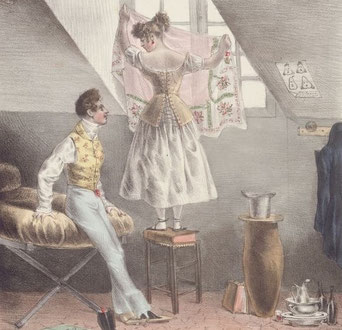
In the French literary tradition, Grisettes are young unmarried working-class women who make a living as hat makers, haberdashers, trim makers, seamstresses or shop assistants, and who usually live alone and unsupervised by their families in the bigger cities. The ‘gris’ in Grisette refers to a cheap but hard-wearing grey cloth which many of these women dressed in on account of their low wages. Many girls left their home villages to move into bigger cities in search of employment and sometimes also of personal freedom from home life. The freedom of movement which these young women enjoyed was very unlike the closely supervised existence of young middle-class women. They did not have male guardians, mothers, governesses, footmen or housemaids to look after them and watch over their every step in public. This level of freedom was commented on in society with apprehension, fascination and moral judgement.
The existence of Grisettes can be considered as a step in the emancipation of women’s personal and economic lives. These women earned their own money and could choose how to live their everyday lives to a certain degree. Nonetheless, in a society so shaped by and for for male heads of families and businesses, it also laid these women open to exploitation and vulnerability. Madame du Barry, mistress of Louis XV, was a Grisette in early life in the 1750s and 1760s. An illegitimate daughter of a garment worker, she moved to Paris as a teenager and became a milliner’s assistant where she was noticed for her looks as well as for her labour. Whether voluntary or (more likely) out of necessity, she utilised this situation. A relationship with the aristocrat Jean du Barry introduced her to the upper echelons of Parisian society where she eventually met the King. He had her married off to du Barry’s brother Comte (Count) Guillaume du Barry, elevating her to the rank of a Countess and making it possible by her noble rank to continue the affair and allow her a place at court.
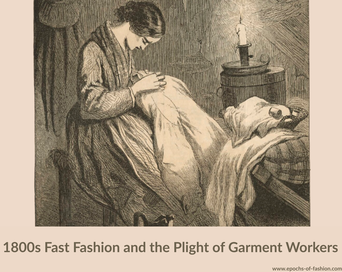
Life stories like the ascent of Madame du Barry added to the romanticising of the Grisette life, such as in literature about these young women and their Bohemian urban circles. The realities of garment workers such as the Grisettes were much more sombre. Being a garment worker in the early nineteenth century was a very hard life with long hours, small wages and no social security to fall back on. Freelance garment work for wealthy commissioners was exhausting and unpredictable.
In the publication The Daughters of England (1842) by Sarah Stickney Ellis, the author impresses upon the well-to-do young female readership to always consider the workers and craftspeople ensuring the reader’s comfort and enjoyment. Ellis (1799-16 June 1872) was a Quaker turned Congregationalist (Calvinist tradition of Protestantism) and published a number of books, chiefly on the moral education of young women. While certainly a writer of her era in terms of treating female independence, Ellis also strongly argues for a considerate and ideally generous treatment of garment workers. She lays out the importance of giving them due time to finish orders and to avoid rushing them with unreasonable or unnecessary deadlines. A rather moving account of a self-employed garment maker worked to the bone by an inconsiderate customer is given in the book to highlight this:
(p. 442) "Let us imagine the case of a young dressmaker, one of that most pitiable, class of human beings, whose pallid countenances, and often deformed and feeble frames, sufficiently attest the unnatural exertions by which they obtain their scanty bread. A young lady wishes to have a dress elaborately made, and for the sake of having it done expeditiously, names the precise day on which it must be finished, adding as a sufficient reason for punctuality, that it must then be worn. The poor dressmaker sits all night long in her little joyless room, working by the light of a thin candle, while the young lady sleeps soundly in her bed. [....] with aching head and weary limbs, she puts away her unfinished task, doubting whether the remainder of the day shall be devoted to the sleep which exhausted nature demands, or to wander abroad to search for purer air, of which that nature is equally in need. The day arrives at last on which the dress must be taken home, according to the appointment. She knocks at the door of the lady's mansion. The servant coolly tells her that her young mistress has gone to spend a few days in the country."
That this is part of an educational book for the daughters of the leisure classes demonstrates that the plight of garment workers was widely known enough to make them the object of social discussion and charitable considerations. Over time, actual legislation was brought in to secure boundaries to working conditions and to introduce safety standards into the garment industries, yet it was slow in coming.
I would like to end on a more positive note than to observe that in many ways, the precarious conditions of the creative industries today with freelance gig work, zero hours contracts,and unpaid internships is not totally dissimilar from the nineteenth-century circumstances, or that garment work internationally is still an incredibly precarious industry. Besides a brief historical perspective on the Grisettes, let this article be a plea for the recognition of the real value of creative labour and a call that it should be compensated fairly.